

Top Signs Your Dryer Needs Repair
Top Signs Your Dryer Needs Repair
Most dryers don’t quit without warning.
The trouble is that the early signals are easy to explain away. Clothes that feel slightly damp. A cycle that runs just a little longer than it used to. A faint smell that disappears after a minute or two. Life gets busy, and homeowners adapt without realizing how much performance has quietly slipped.
Then one day the dryer simply stops doing its job.
Here is the short answer: The most common signs your dryer needs repair include longer drying times, overheating, unusual noises, burning smells, a drum that won’t spin, and cycles that shut off before finishing. These symptoms typically point toward airflow restrictions, heating element failure, faulty thermostats, or worn internal components like drum rollers, belts, or a damaged blower wheel.
Dryers rarely fail without warning. The warning signs just tend to be subtle at first.
This guide breaks down each major symptom, explains what commonly causes it, and helps you understand when basic maintenance is enough versus when professional diagnosis becomes the smarter call. If you’re already past the troubleshooting stage, our Albany appliance repair team is available to help.
Why Dryer Warning Signs Deserve Attention
Dryers generate significant heat during every cycle. That heat has to travel a specific path to work properly, moving through the heating system, airflow channels, lint filter, vent hose, and out through the exhaust vent. Every part of that path matters.
When airflow becomes restricted or internal components begin wearing out, temperatures climb quickly inside the appliance. The dryer works harder, runs hotter, and starts showing symptoms that most homeowners mistake for minor inconveniences.
The U.S. Fire Administration has documented that dryer fires, many linked to lint buildup and restricted exhaust vents, represent a genuine household risk that often develops gradually rather than suddenly.
That doesn’t mean every symptom is an emergency. But ignoring warning signs long enough tends to turn small repairs into expensive ones.
Clothes Are Taking Too Long to Dry
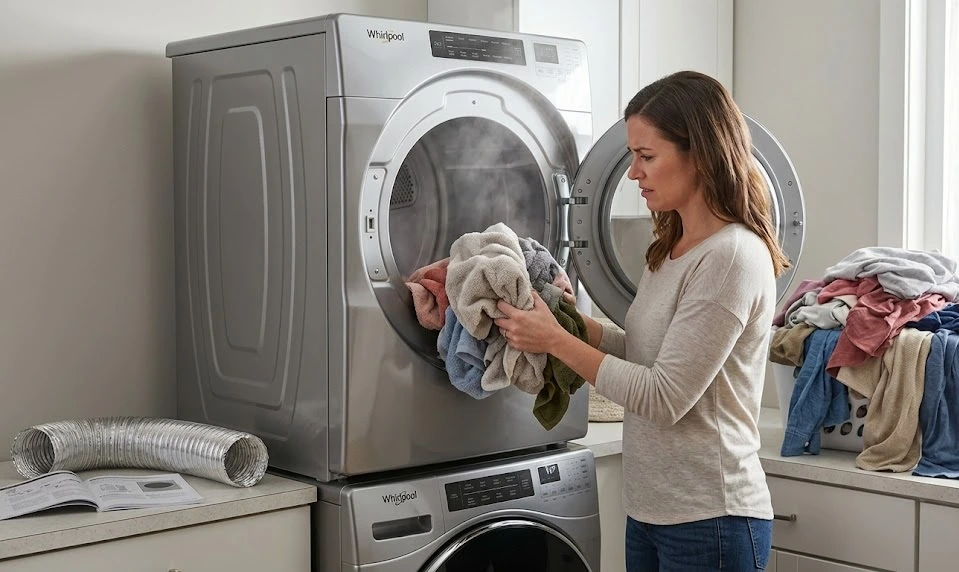
This is probably the most common dryer complaint, and it’s almost always the first sign something is wrong.
A dryer that suddenly needs two cycles to dry a load of towels, or that forces you to crank the heat just to get clothes reasonably dry, is struggling somewhere in its airflow or heating system.
Why this happens:
The most frequent cause is a clogged dryer vent or restricted exhaust hose. Lint builds up gradually inside the vent line, reducing the airflow the dryer needs to push moisture out of the drum. A weak or failing heating element can produce the same symptom. So can a dirty or malfunctioning moisture sensor, which the dryer uses to decide when clothes are actually dry.
Here’s the part that surprises many people: a dryer can feel hot on the outside, even run through a complete cycle, and still dry clothes poorly when airflow is restricted. The heat becomes trapped inside the appliance instead of circulating properly through the exhaust system. The drum fills with humid, warm air that never fully escapes.
If drying times have crept up gradually, start with the lint filter and vent line. But if cleaning those doesn’t restore normal performance, the heating element or moisture sensor may need professional inspection.
Dryer Not Heating at All
When clothes come out of the dryer damp no matter how long the cycle runs, the heating system itself is likely the problem.
Common causes include:
- A failed heating element (the most common cause in electric dryers)
- A blown thermal fuse, which is a one-time safety device that shuts off heat permanently once triggered
- A faulty thermostat that can no longer regulate temperature accurately
- A damaged igniter or gas valve issue in gas dryers
- Control board failure
Electric and gas dryers fail differently, but the experience for the homeowner feels the same: the drum turns, the cycle runs, and the clothes stay cold and wet.
One thing worth knowing about modern dryers: many include automatic overheating protection that shuts down the heating assembly if internal temperatures climb too high. This safety feature is genuinely useful, but it creates confusing symptoms. The dryer appears to be working because it runs normally, but heating has been disabled by the safety system.
That situation almost always traces back to airflow restriction. The vent is blocked, temperatures spike, and the dryer cuts heat to protect itself. Cleaning the vent fixes airflow, but a blown thermal fuse from repeated overheating usually needs replacement regardless. If you’re dealing with this in Albany, our dryer repair service can properly diagnose whether the fuse, thermostat, or heating element is the root cause.
A Burning Smell Coming From the Dryer
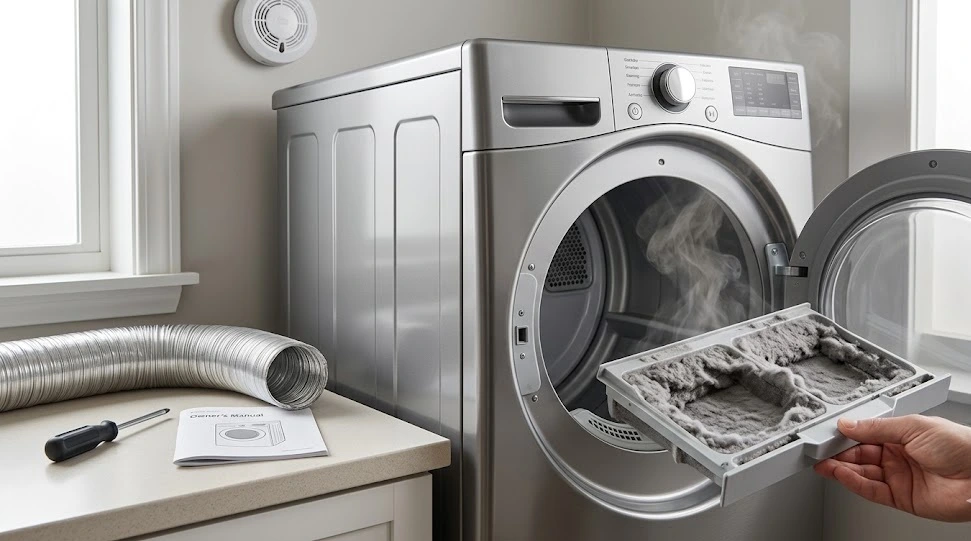
Stop the dryer and do not restart it until the source of a burning smell is identified.
This is one warning sign that genuinely cannot wait.
What burning smells typically indicate:
- Lint accumulation near the heating element or motor
- An overheating motor struggling against excess load or bearing failure
- A worn or slipping belt generating heat through friction
- Damaged electrical wiring or connections
- Restricted exhaust vent causing internal heat buildup
The smell varies depending on the cause. Burning lint tends to smell dusty and sharp. A failing belt or roller often produces a rubbery smell. Electrical problems sometimes smell like hot plastic or something chemical.
Lint is genuinely flammable, and even partial airflow restrictions raise internal temperatures significantly during a normal drying cycle. A dryer vent clogged with lint is not just an efficiency problem. It’s a fire risk.
If the smell appears during the first few minutes of a cycle and then disappears, that sometimes indicates older lint burning off near the heating element. But a persistent smell, or one that grows stronger during the cycle, warrants professional inspection rather than continued use.
The Dryer Is Making Loud or Unusual Noises
Some dryer noise is completely normal. Light mechanical humming, the soft tumble of the drum, the occasional small item rolling around inside.
Loud, unfamiliar noises are different.
What the sound usually tells you:
- Thumping or banging: Often worn drum rollers or a drum that has shifted slightly out of alignment
- Squealing or high-pitched squeaking: Commonly a worn drum bearing, failing idler pulley, or a belt that needs replacement
- Grinding or scraping: Frequently points toward debris caught in the drum seal, a damaged blower wheel, or worn drum support components
- Rattling: Sometimes loose hardware, but can also indicate a blower wheel that has cracked or come partially loose
Dryer noises tend to follow a frustrating pattern: they appear intermittently at first. The sound shows up for a cycle or two, then disappears for a week. Homeowners reasonably conclude it was nothing. But the noise returns, gradually becoming more frequent and louder until the component fails completely.
Worn drum rollers are a good example of this. They often create a thumping noise when cold that quiets down once the dryer warms up. The noise seems to resolve itself, but the rollers are still deteriorating.
Catching these symptoms early almost always means a simpler, less expensive repair than waiting for the component to fail entirely.
The Dryer Drum Stops Spinning
A dryer that powers on, makes normal sounds, but doesn’t actually tumble the clothes has a mechanical problem rather than an electrical one in most cases.
Likely causes:
- A broken drive belt, which is the single most common cause in older dryers
- A worn or seized idler pulley that keeps the belt under tension
- Failing drum rollers that have become too worn to support the drum’s weight
- A motor that’s functioning but unable to transfer power properly
When the drive belt breaks, many dryers will power on and appear normal except the drum sits completely still. Sometimes the motor hums quietly while nothing moves. That pattern, motor running with a motionless drum, points toward belt or pulley failure more often than motor or electrical problems.
Drum rollers tell a slightly different story. When they wear severely, the drum can drag instead of stopping entirely, making the motor work harder and eventually causing the belt to slip or the thermal overload protection to trip.
The Dryer Shuts Off Before the Cycle Ends
Unexpected mid-cycle shutdowns tend to puzzle homeowners because the dryer seems to be working right up until it stops.
What’s usually happening:
The dryer’s built-in safety systems are doing exactly what they’re designed to do. When internal temperatures climb too high, typically because of restricted airflow, the thermostat or thermal cut-off triggers a shutdown to prevent overheating damage or fire risk.
The dryer isn’t broken in the traditional sense. It’s stopping itself because conditions inside have become unsafe for continued operation.
Other causes include a faulty moisture sensor that incorrectly signals the clothes are dry before they actually are, a motor beginning to overheat under load, or ventilation issues that cause the appliance to cycle the thermal protection repeatedly.
The frustrating part is that the dryer may restart after cooling down and run fine for another twenty minutes before shutting off again. That cycle of partial operation followed by shutdown is a fairly reliable sign that airflow or overheating is the root issue rather than an electrical fault.
What Causes Most Dryer Problems?
Looking across all these symptoms, most dryer failures trace back to three categories:
Airflow restrictions are the most common underlying cause. Lint buildup in the exhaust vent, a kinked or crushed vent hose, or a blocked exterior vent cap reduces the airflow the dryer depends on. This affects drying efficiency, temperature regulation, moisture removal, motor strain, and fire safety simultaneously.
Heating system failures include the heating element, thermal fuse, thermostat, and related components. These wear out naturally over years of use, but airflow problems accelerate their deterioration significantly.
Worn mechanical components cover drum rollers, drive belts, idler pulleys, blower wheels, and motor bearings. These parts handle physical stress during every cycle and eventually wear out regardless of how well the dryer is maintained.
Most major dryer brands, including Whirlpool, Samsung, LG, GE, Maytag, Electrolux, and Kenmore, use variations of these same core components. The failure patterns are remarkably similar across brands and models.
DIY Maintenance vs. When to Call a Professional
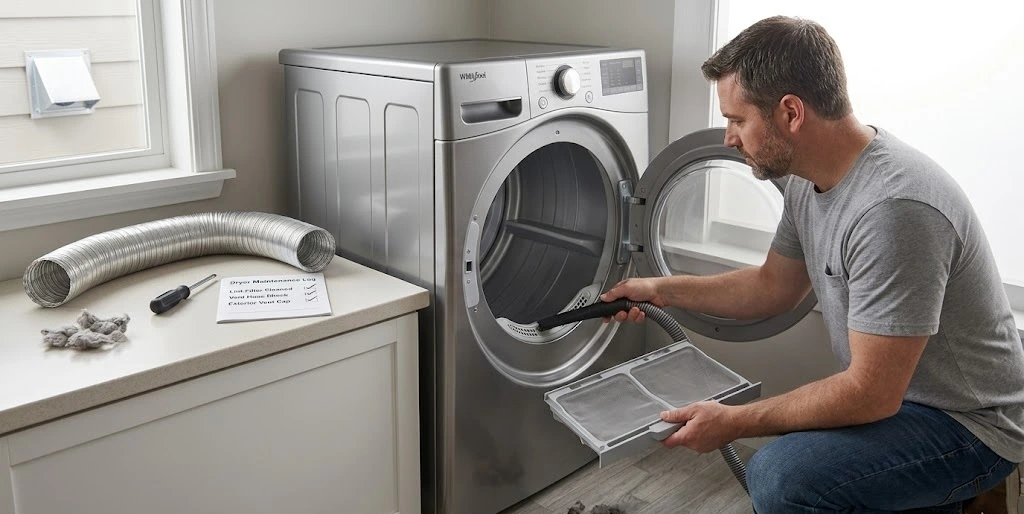
Some dryer maintenance genuinely belongs in the homeowner’s regular routine:
- Cleaning the lint filter after every load
- Inspecting the vent hose for kinks, crushing, or disconnection
- Checking outside airflow at the exterior vent cap
- Scheduling a professional vent cleaning every one to two years, especially for longer vent runs
These habits prevent a large percentage of airflow-related problems before they develop.
But certain dryer symptoms should not be handled through casual troubleshooting:
- Burning smells of any kind
- Repeated overheating or thermal shutdowns
- Grinding or scraping sounds that suggest debris or mechanical damage
- Electrical irregularities or control failures
- Gas-related symptoms in gas dryers
Modern dryers contain heating assemblies, electronic controls, moisture sensing systems, and in gas models, ignition components that interact with the gas supply. Replacing the wrong part, misdiagnosing the root cause, or reassembling components incorrectly can create larger appliance problems than the original symptom.
If your dryer continues showing warning signs after basic vent and filter maintenance, a professional diagnosis often identifies the actual cause more quickly and safely than working through the possibilities yourself.
For homeowners in the Capital Region dealing with persistent dryer symptoms, our dryer repair service page covers what professional inspection involves and what to expect from the process.
How to Prevent Common Dryer Problems
The maintenance habits that actually extend dryer life are simple but easy to skip when life gets busy.
Clean the lint filter every single load. Not every few loads. Every load. Even a thin layer of lint reduces airflow measurably over time.
Inspect the vent hose behind the dryer periodically. Vent hoses get compressed when the dryer is pushed back against the wall, and flexible foil hoses can collapse internally without looking damaged from outside. Rigid or semi-rigid metal duct performs better and lasts longer.
Check the exterior vent cap seasonally. Lint and debris collect at the exterior cap and reduce airflow. Birds occasionally nest in them. Ice can block them in winter.
Avoid running oversized loads consistently. Heavy, wet loads strain the motor, belts, and drum rollers with every cycle. The dryer technically handles them, but the mechanical wear accumulates faster than with properly sized loads.
Consider a professional vent cleaning every one to two years if your vent run is longer than six feet or includes multiple bends. Lint accumulates in those systems faster than homeowners typically expect. This is especially true in colder climates where condensation inside the vent line adds to the buildup problem. Appliance technicians handling dryer repair in Fargo, ND note that winter months consistently produce more vent-related service calls for exactly this reason.
Frequently Asked Questions
Why is my dryer taking so long to dry clothes?
Extended drying times almost always point toward restricted airflow, a clogged dryer vent, a failing heating element, or a malfunctioning moisture sensor. Start by cleaning the lint filter and inspecting the vent hose for blockages. If performance doesn’t improve, the heating system likely needs professional inspection.
Is a burning smell from the dryer dangerous?
Yes. Stop the dryer immediately. Burning odors can indicate lint buildup near the heating element, a slipping belt generating friction heat, overheating motor components, or electrical problems. Any of these situations warrants professional inspection before the dryer is used again.
Why does my dryer keep shutting off before the cycle ends?
Mid-cycle shutdowns usually indicate the dryer’s overheating protection is activating. The most common cause is restricted airflow from a clogged vent or blocked exhaust hose. A faulty moisture sensor or an overheating motor can also trigger early shutdowns.
Can clogged dryer vents really damage the appliance?
Yes, significantly. Restricted airflow causes heat to build up inside the dryer, which forces the heating element, motor, and thermal components to work under higher stress. This accelerates wear, triggers safety shutdowns, and in serious cases creates fire risk. Regular vent maintenance directly extends appliance lifespan.
My dryer drum isn’t spinning but the motor sounds like it’s running. What’s wrong?
This pattern almost always points to a broken drive belt. When the belt snaps, the motor continues running but can no longer turn the drum. It’s one of the more straightforward mechanical repairs on a dryer, and catching it before the motor runs hot from unloaded operation prevents additional damage.
How long should a dryer typically last?
Most dryers last between ten and thirteen years with regular maintenance. Airflow maintenance, specifically keeping the vent system clean, is the single biggest factor in whether a dryer reaches the upper end of that range or fails well short of it.
When should I repair versus replace a dryer?
If a dryer is under eight years old and the repair cost is less than half the price of a comparable new unit, repair usually makes financial sense. Older dryers with multiple failing components, or those with a history of repeated repairs, may not be worth investing in further.
Closing Thoughts
Dryers communicate clearly when something is wrong. Longer drying times, strange noises, extra heat, burning smells, damp clothes after a full cycle. These aren’t random malfunctions. They’re specific symptoms pointing toward specific problems.
The earlier those symptoms get attention, the simpler and less expensive repairs tend to be. What starts as a clogged vent that takes ten minutes to clean can become a blown thermal fuse, a failed heating element, or a damaged motor if ignored long enough.
Most dryer problems are fixable. The window for a simple repair just closes faster than most homeowners expect.
If you’re also dealing with problems across other appliances, our guides on common washing machine symptoms, refrigerator warning signs, and dishwasher troubleshooting cover similar symptom-based guidance for the rest of your kitchen and laundry room.